Category: Solar PhotoVoltaic (PV)

  • Is a Solar On-Grid System Right for Your Home or Business in Saudi Arabia?

    Is a Solar On-Grid System Right for Your Home or Business in Saudi Arabia?

    Is a Solar On-Grid System Right for Your Home or Business in Saudi Arabia?

    Introduction

    In Saudi Arabia, many individuals and businesses are considering the installation of solar on-grid systems. With the increasing affordability and popularity of solar power, it’s tempting to jump right in. However, it’s crucial to evaluate specific factors before determining if a solar on-grid system is the right choice for your home or business.

    Researching Laws and Regulations

    Before proceeding, it’s essential to thoroughly research the laws and regulations governing solar energy in Saudi Arabia. The official Shamsi.gov.sa website is an excellent resource for detailed information on legal and technical requirements, as well as a directory of certified installers across the country.

    Sizing and Installation

    Once you’ve ensured compliance with Shamsi’s standards, it’s time to focus on sizing and installing your solar system. Conducting a self-consumption analysis is critical in identifying the most cost-effective size and configuration for your specific needs. This analysis becomes even more crucial for businesses, as the costs and benefits can vary based on the company’s size and energy consumption profile.

    Selecting a Qualified Solar Contractor

    Choosing the right solar contractor is paramount to the success of your solar energy project. Here are key considerations when shortlisting contractors:

    1. Experience and Track Record: Evaluate a contractor’s past performance, including their experience and track record in the solar industry. Assess their previous projects, their scale, complexity, and client feedback to gauge their ability to handle your specific requirements.
    2. Quality Assurance: Look for contractors with ISO 9001 certification for quality management systems. This certification indicates adherence to international standards and best practices, ensuring the delivery of quality work, efficient processes, and customer satisfaction.
    3. Expertise and Training: Assess the professionalism and expertise of a contractor’s personnel. Ensure their proposed design aligns with the regulatory framework established by MOMRA and SEC.
    4. Long-Term Support and Warranty: Inquire about the contractor’s post-installation services, including maintenance, warranty, and support options. Reputable contractors offer ongoing maintenance programs to optimize system performance and provide warranties that protect your investment.

    Conclusion

    Installing a solar on-grid system is an excellent way to save money and reduce your carbon footprint. However, it’s crucial to navigate the process carefully. Ensure legal compliance by consulting the Shamsi website, conduct a self-consumption analysis to size your system appropriately, and take advantage of a list of qualified contractors and consultants for a successful implementation of your solar energy project.

    Sources:

    https://shamsi.gov.sa/en/Pages/home.aspx

    https://www.se.com.sa/en-us/customers/Pages/solarPV/intro.aspx

  • Active Cooling Technology for Inverters – Fronius

    Active Cooling Technology for Inverters – Fronius

    “WITH EVERY 10 °C RISE IN TEMPERATURE, THE SERVICE LIFE IS REDUCED BY ROUGHLY HALF.”

    Active Cooling Technology for Inverters – Fronius

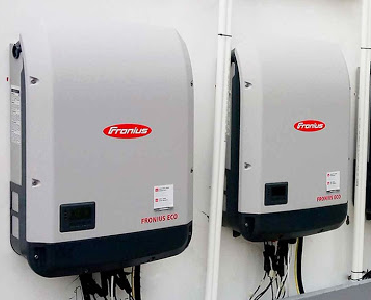
    As you know, high ambient temperatures not only affect the yield of the PV system, but can also have a huge impact on the service life of the inverters. Contrary to many other manufacturers, Fronius relies on active rather than passive cooling of the power electronics. In addition to preventing so-called hot spots, the focus with this approach is on optimizing yields as well as simple and flexible system design.

    ACTIVE VS. PASSIVE COOLING

    Passive cooling relies on natural convection and only internal fans, if any, are used. Large heat sinks also makes the device heavy, which means handling and transport are more difficult.

    In comparison, active cooling technology relies on one or more fans, which not only avoid hot spots, but also regulate the air circulation inside the inverter. This keeps the temperature of the power electronics low.

    MAXIMUM FLEXIBILITY IN SYSTEM DESIGN AND INSTALLATION

    Due to the often limited amperage of MPP trackers for passively cooled devices, only one module string can usually be connected per tracker. This is because higher amperages also cause higher component temperatures.

    Actively cooled devices, on the other hand, can dissipate more heat, which in turn allows higher amperages. This means greater flexibility in system design, as more parallel strings can be connected.

    Inverters with active cooling also offer maximum flexibility during installation. In contrast to passive cooling, devices with an active cooling system can be mounted on a roof in a vertical, horizontal, and even flat position. This is because the cool air is drawn in from the side and the heated air is dissipated upwards. With heat dissipation up to five times higher than the passive version, actively cooled inverters can even be installed in locations with higher levels of solar radiation.

    MAINTENANCE-FREE TECHNOLOGY WITH COST SAVINGS

    For the warranty to be maintained, all manufacturers of passive cooling systems stipulate that the equipment must be serviced at regular intervals. A variety of inverter factors, such as the cleanliness of the heat sinks, the operating status of the system, cable connections and the grounding terminal must be checked up to twice a year by an appropriate specialist.

    Inverters with an active cooling system are usually maintenance-free, so ongoing costs are considerably reduced. However, regular checks should not be completely omitted, especially if the inverter is in an area exposed to high levels of dust or dirt.

    POSITIVE EFFECT ON SERVICE LIFE

    Since the service life of electronic components is highly temperature-dependent, the hotter these components become, the higher the probability of failure.

    For this reason, electronic components are cooled in a targeted manner by internal fans with an active cooling system, thus ensuring a longer service life of the power electronics. This also means considerable cost savings, as the load on the individual components is significant reduced and repairs are needed less frequently.

    On the other hand, restricted heat dissipation in inverters with passive cooling can lead to local hot spots, which significantly reduces the service life.

    OPTIMIZATION OF YIELD THROUGH ACTIVE COOLING

    In order to avoid overheating of the electronic components, there is a so-called “derating” function – a controlled power reduction. With actively cooled inverters, the cooling effect caused by the fans is much stronger than with a passive cooling system, where greater yield losses are unavoidable.

    As can be seen in the diagram, the passively cooled inverter switches to power derating at ambient temperatures of 30 °C, while the actively cooled Fronius inverter only starts this process from 40 °C.

  • Enhancing the Value of a Commercial Rooftop Photovoltaic System with Tubular Daylighting

    Enhancing the Value of a Commercial Rooftop Photovoltaic System with Tubular Daylighting

    Enhancing the Value of a Commercial Rooftop Photovoltaic System with Tubular Daylighting
    Photovoltaic and Tubular Daylighting Systems

    Photovoltaic Rooftop Market Rooftop solar photovoltaic (PV) systems are becoming a preferred source of energy worldwide. Declining PV equipment costs are reducing end-user kWh cost equivalents to levels below the cost of utility-generated energy in many countries. The future of the global rooftop solar PV market appears to be very bright and promising. 

    A recent report from Transparency Market Research titled “ Rooftop Solar PV Market – Global Industry Analysis, Size, Share, Growth Trends, and Forecast 2015 – 2023” projects that the global rooftop PV market will grow to $4.58 billion by 2023. North America currently accounts for the largest share of the global rooftop PV market, but growth rates in the Asia Pacific Region are predicted to outpace all other regions to represent $1.09 billion of the global rooftop market by 2023. India and China are expected to be the main drivers of this growth.

    PV solution providers are scaling-up to accommodate rapid market growth, but declining equipment costs decrease PV solution provider per-project revenue and profit. Increased price competition between solution providers exacerbates this problem, because offering a lower price (with lower-margin) is often needed to win the deal. Incorporating TDDs into a PV system design reduces this negative impact on profitability as discussed in the following sections of this article.

    Tubular Daylight Devices Tubular Daylighting Devices, or TDDs, are high-performance optical lighting solutions that bring daylight into buildings, and can be an especially-effective solution for interior areas where traditional skylights and windows cannot reach. TDDs are sometimes called “tubular skylights,” “light tubes,” “sun pipes,” and even “light tunnels,” TDD technology is composed of three zones that capture, transfer, and deliver daylight. The components in each zone incorporate designs that consistently deliver the maximum amount of “good” visible light while excluding damaging UV light as well as excluding excess heat from infrared light. TDDs are designed to deliver stable light levels throughout the day and throughout the seasons to provide a consistent daytime lighting environment to building occupants. TDDs are sealed, require no power to operate, do not have moving parts, and do not require maintenance.

    TDD technology can direct light through long tubing runs that includes multiple angle bends. This allows the exterior light-collecting domes to be clustered into groups that leave more rooftop space available for PV panels. This property can enhance the value of a PV system implementation as discussed in the following sections of this article.

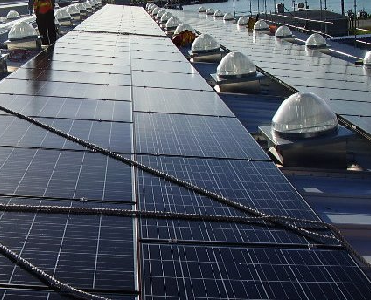
    Roof Space Limitations with Traditional Skylights Available rooftop space is often inadequate to install a PV system that meets all commercial end-user energy need. Contributing factors to this limitation are that most building codes require commercial rooftops to include skylights and that building codes also require a 4-foot setback from each skylight as well as a 6-foot-wide access path to each skylight. This constraint dramatically reduces available space for PV modules. The photo above is a commercial rooftop installation with traditional skylights that demonstrates this constraint.

    Traditional skylights are positioned directly over the interior areas they illuminate, so their layout is generally dispersed uniformly over the roof area. This positional constraint of traditional skylights makes it necessary to fragment the PV panel layout on the roof. The green area in the example schematic layout to the right demonstrates this limitation. The green area is the maximum space available for a PV system with a typical traditional skylight layout. About 67% of the roof area is available for PV in this example.

    Utilizing TDDs to Make More Roof Space for PV Panels TDD light-collecting domes can be grouped-together as shown in the photo below. The second photo below demonstrates how TDDs can be configured to direct light through reflective tubing to where it is needed inside the building. Unlike traditional skylights, TDDs do not need to be positioned directly over the interior area they illuminate. The rooftop domes of TDDs can be concentrated in smaller roof areas to make more space for PV panels.

    Reducing the Installed Cost/Watt of PV Roofs with traditional skylights generally require asymmetrical PV layouts and such asymmetrical designs tend to cost more due to the additional racking, wire and labor required. Large, symmetrical PV arrays tend to have a lower total cost per installed watt for this reason. Incorporating TDDs into a PV design enables the design of more-symmetrical PV panel layouts which reduces system cost. Additional cost savings can increase the economic benefit to both the end-user as well as profit margin to the system provider.

    Basis for TDD Operational Savings TDDs save electric lighting expense in a straightforward way. As daylight levels increase in the morning, interior electric lights are dimmed or switched-off, typically with an automation system. As daylight levels decrease in the evening, the lights are brightened or switched-on.

    Electric lighting wastes around 70% of input kWh as heat generated inside the building. HVAC equipment in needed to remove this heat energy added to the building. HVAC equipment consumes energy to remove this waste heat from a building interior. Deploying a TDD system enables the end-user to turn-off electric lighting systems to reduce waste heat added to building interiors and reduce the corresponding HVAC energy consumption to remove the waste heat.

    Electric lights have a finite operational hour lifetime. Daylighting with TDDs reduces the number of hours electric lights are used each day. This reduced electric light usage adds-up and extends electric light calendar life. With a longer calendar life, costly lighting equipment replacements can be avoided or deferred to create additional savings for the end-user.

    PV and TDD Financial Return Similarity Adding TDDs to a rooftop PV implementation extends economic benefit to the building owner with financial returns comparable to PV. The figure to the right compares financial returns between typical rooftop PV and TDD deployments. Both TDD or PV systems generate similar financial return for the end user with paybacks as short as four years and rates of return up to 40% per year. Economic metric similarity makes it possible for an end-user to apply a similar decision process for both PV and TDD systems. Economic metric similarity also makes it possible for the PV solution provider to communicate a TDD value proposition to an end-user in a manner similar to PV.

    Global Economic Benefit Parity The similarity of financial return between TDD and PV technology is global. When both are deployed in the same location, anywhere in the world, they both generate similar financial returns. This is because the economic benifit from both technologies is driven by the same factors: available sunlight (same in one location), capital expense for equipment (similar for each technology throughout the world) and utility kWh energy cost (same at one facility).

    Summary Combining TDDs with rooftop solar PV systems generates additional financial value to both the PV solution provider and the end-user. The basis for this additional value is that TDDS make more roof space available to install more PV panels, more symmetrically. More-symmetrical PV panel arrays decrease PV system cost. A larger PV system generates more revenue for the PV solution provider and more energy savings for the end-user. TDDs save money for end-users by reducing electrical light usage, deferring electric light fixture replacement and reducing HVAC energy usage. The financial returns from a solar PV or TDD investment are similar.

  • What are the Components of a Photovoltaic System?

    What are the Components of a Photovoltaic System?

    What are the Components of a Photovoltaic System?

    A Photovoltaic (PV) System is a power system designed to supply usable solar power by means of photovoltaics – consisting of several components such as DC-AC power inverter, battery bank, system and battery controller, and auxiliary energy sources.

    Due to the relatively low maintenance requirements and the long lifetime of many of the system components, solar electric systems are among the most popular renewable energy options available – and that includes commercial photovoltaic systems in Saudi Arabia.

    Ranging from small building-integrated systems to large utility-scale power stations of hundreds of megawatts, most PV systems nowadays are grid connected, while off-grid or stand alone systems only account for a small portion of the market.

    The two photovoltaic-based systems, Grid Connected and Stand Alone Systems, are classified according to functional and operational requirements, component configuration, and how the equipment is connected to the other power sources and electrical loads.

    Grid Connected

    Grid Connected

    An electricity generating solar PV power system that is connected to the utility grid, the grid connected photovoltaic power system (also known as the grid connected PV power system) ranges widely from small residential and commercial rooftop systems to large utility-scale solar power stations. This consists of solar panels, one or several inverters, a power conditioning unit, and grid connection equipment.

    Compared to stand alone power systems, a grid connected system rarely includes an integrated battery solution. When conditions are right, the grid connected PV system supplies the excess power back to the grid for which the client can receive rebates in following months.

    Advantages of Grid Connected

    • Easier to install as they don’t need a battery system
    • Effectively utilizes generated power as there is no storage loss involved
    • Predictable average reduction of carbon consumption even though the sun doesn’t always shine
    • Can offset the customer’s electricity usage costs

    Stand Alone

    Stand Alone

    Suited for locations that are not fitted with an electricity distribution system, the stand alone power system (SPS), also known as remote area power supply (RAPS), typically includes one or more methods of electricity generation, energy storage, and regulation.

    It is usually used as a battery bank; however, other solutions exist including fuel cells. The power drawn directly from the battery is called the Direct Current Extra Low Voltage (DC ELV). This is also used for lighting and DC appliances. This type of photovoltaic power systems is independent of the utility grid and can only use solar panels – it may also be used in conjunction with a diesel generator, wind turbine, or batteries.

    Two Types of Stand alone

    Direct coupled system

    This is a type of stand alone PV system which consists of a solar panel connected directly to a DC load. Since it has no battery banks, there is no energy stored. However, it is capable of powering common appliances during the day.

    Stand alone systems with battery

    Granted that a direct coupled system has no battery, there is another schematic of a stand alone PV system that has a battery and a charger. The primary functions of a storage battery in a stand alone PV system are:

    • Energy storage capacity and autonomy
    • Voltage and current stabilization
    • Supply surge currents

    Photovoltaic Array

    If photovoltaic solar panels are made up of individual photovoltaic cells connected together, a system made up of a group of solar panels connected together is called the Solar Photovoltaic Array (also known simply as Solar Array).

    In layman’s term, a photovoltaic array is composed of multiple solar panels that are electrically wired together to form a much larger PV system. The larger the total surface area of the array, the more solar electricity it will produce.

    Battery Bank

    Solar PV Systems often produce energy at times when it’s not needed; hence, they are stored and used when there is no other energy input. Whenever this happens, there are two methods done to the excess energy: it is either sold to the electric utility or stored in batteries. If the second option is chosen, these batteries can discharge rapidly and yield more current than the charging source can provide for itself, helping pumps and motors to run intermittently.

    There are two main reasons for deciding to use battery storage:

    • Maximize savings – The rate paid is normally below the kWh price charged for consumption whenever the production of excess energy is sold to the electric utility. However, other PV system owners save the full price by storing the surplus and only utilizing it when needed, instead of selling at a reduced price.
    • Back-up power – Store the surplus energy for electric service interruptions.

    Considerably, they tend to raise the cost of a PV system, which means savings are only feasible when there is a drastic energy price increase during peak demand hours.

    Power Conditioning Unit

    Another main component, the Solar Power Conditioning Unit (PCU) acts as an integrated system that consists of a solar charge controller, inverter and a Grid charger. It is responsible for providing the facility to charge the battery bank either through a Solar or a Grid/Distributed Generation (DG) set.

    If the battery voltage goes below a set level, the PCU’s jobs is to voluntarily transfer the load to the Grid/DG power and to charge simultaneously – and it’s all because of the constant usage of power.  When the solar power or battery charger cannot meet the load requirement, the PCU will give the solar power a preference and will use the Grid/DG power.

    AC and DC Disconnect

    The Solar PV System has two safety disconnects – the Array DC Disconnect (also known as the PV Disconnect) and the AC Disconnect. The DC Disconnect allows the DC current between the modules to be interrupted before it reaches the inverter. On the other hand, the AC Disconnect separates the inverter for the electrical grid.

    For safety reasons, electric systems must be equipped with a manual disconnection device which is made to protect technical personnel from electric shock during system maintenance. Other than its safety functions, the circuit can be interrupted if there is an emergency.

    Main Panel

    After the output from the PV system has been finally converted to AC power (reaching the adequate frequency), energy can now be provided with the electric utility once connected to the main panel where all electric loads in the building are connected and protected with circuit breakers.

    EGPHIL Solar Solutions works intensively to provide the best commercial photovoltaic systems in Saudi Arabia. We also aim to witness an endless smile of fulfilment on each of our Solar Alternative Energy Patron. Call us on +966 12 668 1177 and get the different benefits of having an efficient PV system now!