Category: Uncategorized

  • What Is The Optimal Orientation And Tilt Angle For Solar Panels?

    What Is The Optimal Orientation And Tilt Angle For Solar Panels?

    Solar panels have become increasingly popular for homeowners seeking to reduce their carbon footprint and energy costs. However, to maximize efficiency and output, it is essential to understand which orientation and tilt angle will produce maximum output and efficiency.

    What is the best tilt angle for solar panels? This blog will discuss all factors determining optimal placement for solar panels. By providing enough information, you can decide which system fits you best.

    Importance Of Solar Panel Orientation

    The orientation of solar panels generally refers to their direction, whether facing north, south, east, or west when placed. While it may seem that any direction would suffice, the orientation of solar panels has great significance on their performance and energy production. Moreover, it ensures that solar panels receive maximum exposure to sunlight throughout the day.

    Solar Panel Orientation

    Usually, solar panels are installed to face the true south in the northern hemisphere and the true north in the southern hemisphere. It ensures that the panels receive maximum exposure to sunlight throughout the day. 

    Solar panels facing directly east or west can experience a decrease in energy production of approx 20%. At the same time, panels facing true south or true north yield the highest energy output.

    Besides, the angle of solar panels affects energy production, and improper orientation can significantly reduce electricity generation. It is essential to prioritize orientation to ensure optimal exposure time to the sun.

    Understanding Solar Panel Angle

    Solar panel angle, also known as tilt angle, refers to the vertical tilt at which solar panels are installed. The angle of solar panels is critical in optimizing their exposure to sunlight throughout the year. It is important to note that the solar panels that are mounted perpendicular to the sun will generate more electricity. 

    The ideal angle for solar panel installations depends on geographic location and time of year. In most of the United States, the ideal solar panel installation angle should fall between 30 and 45 degrees, according to most homeowner installation sites.

    Factors Affecting An Ideal Solar Panel Angle

    Factors Affecting An Ideal Solar Panel Angle

    Several factors influence the optimal angle for solar panels. By considering these factors, homeowners can determine the best tilt and orientation for their solar panels.

    1. Latitude

    The latitude of the installation site is a crucial factor in determining the optimal solar panel angle. Solar panels should be installed at an angle that maximizes sunlight exposure for their intended location. The optimal angle should be close or equal to the latitude of the home or property.

    For example, homeowners residing in areas with a latitude of 40 degrees would aim to install solar panels at a similar angle. By aligning the tilt of the panels with the latitude, homeowners can maximize energy production throughout the year.

    2. Time And Seasonal Adjustments

    Changes in season and time of year can tremendously affect solar panel efficiency. When sunlight drops lower in the sky during winter, solar panels may experience decreased energy production due to the reduced intensity of sunlight.

    To account for seasonal variations in solar panel production, homeowners can adjust the tilt twice yearly (in spring and fall) by shifting it toward steeper angles in winter and shallower ones in summer, optimizing energy production throughout the year.

    Moreover, homeowners in regions with heavy snowfall should consider the angle of their solar panels to facilitate the easy shedding of snow. A steeper angle prevents snow accumulation and maintains optimal energy production during winter.

    3. Roof Tilt

    The tilt of the roof plays a significant role in solar panel placement. Steep roofs may pose challenges in achieving the optimal tilt angle with traditional racking systems. In such cases, solar panels may need to be installed flat against the roof, compromising some energy production.

    Low-angle roofs also present challenges, as specialized racking may be necessary to achieve the optimal tilt angle. Installing solar panels flush against low-angle roofs can reduce electricity production and lower solar savings.

    Determining An Ideal Solar Panel Tilt Angle

    Determining An Ideal Solar Panel Tilt Angle

    Establishing the optimal angle for solar panels requires careful consideration of several factors. Latitude provides a general guideline, while homeowners can utilize online tools and resources to calculate an ideal tilt for their specific location.

    One method is to perform a Google search for the latitude of your home address or zip code. Typically, the ideal angle for solar panels will equal or close to your home address or zip code’s latitude. However, seasonal adjustments may need to be made periodically for accurate assessment.

    Which Is More Important, Orientation Or Tilt Angle?

    Which Is More Important, Orientation Or Tilt Angle?

    When considering the optimal positioning for solar panels, homeowners often wonder whether orientation or angle is more critical. Both factors play significant roles in determining energy production, but the direction solar panels face takes precedence over the tilt angle.

    Although the angle of solar panels is essential, it is secondary to orientation when it comes to energy production. The optimal angle allows for better light absorption and a smaller angle of incidence, maximizing energy conversion.

    However, improper orientation can reduce energy production even with the correct angle. To balance orientation and tilt, homeowners should prioritize proper orientation and adjust the angle to optimize energy production further. By aligning both factors, homeowners can achieve the highest levels of energy efficiency.

    Advanced Techniques: Solar Tracking Systems

    Solar tracking systems offer an advanced solution to optimize solar panel performance. These systems automatically adjust the angle and orientation of solar panels throughout the day, following the sun’s path to maximize sunlight exposure. 

    Solar tracking systems enhance energy production but have higher costs and maintenance requirements. Commercial installations often opt for these systems as their ability to track the sun’s movement accurately.

    Conclusion

    Understanding solar panels’ optimal orientation and tilt angle is crucial for maximizing energy production and savings. Proper orientation ensures that solar panels receive maximum exposure to sunlight, while the correct tilt angle enhances energy conversion.

  • How Solar Energy Is Converted Into Electricity Using Solar Panels

    How Solar Energy Is Converted Into Electricity Using Solar Panels

    Solar energy has become an increasingly popular alternative energy source as a renewable resource. It harnesses the power that comes naturally from the sun and converts it into usable electricity. This process is possible through solar panels containing photovoltaic cells that convert light into electrical energy. 

    This article will explore the science and technology behind how solar energy is transformed into electricity.

    The Basics Of Solar Energy

    Before delving into the specifics of how solar panels work, it’s essential to understand the basics of solar energy. Solar energy is a type of renewable energy derived from the sun.

    It is a clean and abundant source of energy that can be harnessed and used to generate electricity. Solar panels are designed to capture sunlight and convert it into usable electricity through a process known as the photovoltaic effect. Solar panels comprise silicon cells, metal frames, glass casings, and wiring.

    The Basics Of Solar Energy 21

    The Photovoltaic Effect Explained

    The photovoltaic effect is the phenomenon that allows solar panels to convert sunlight into electricity. It was discovered by French physicist Edmond Becquerel in 1839 when he noticed that the electric current in a solution was enhanced when light was shined on it.

    The photovoltaic effect occurs when photons and light particles strike a photoelectric surface, such as a semiconductor material. When photons strike the surface of a solar panel, they transfer their energy to the electrons in the semiconductor material, causing them to become excited.

    This excitation allows the electrons to break free from their atomic bonds and move freely through the material, creating an electric current. This flow of electrons is what generates electricity in a solar panel.

    The Role Of Semiconductors In Solar Panels

    Semiconductors are crucial components in solar panels as they enable the photovoltaic effect to occur. A semiconductor is a material that conducts electricity better than an insulator but not as well as a conductor.

    Silicon is the most commonly used semiconductor material in solar panels due to its abundance and favorable electrical properties.

    Solar panels typically comprise silicon wafers, thin slices of crystalline silicon. These wafers are doped, or infused with impurities, to create a natural electric field within the material.

    The doping process involves adding atoms with extra electrons (n-type doping) or atoms with missing electrons (p-type doping) to the silicon crystal.

    The doped silicon wafers create a p-n junction, a boundary layer between the n-type and p-type regions of the crystal. This junction is where the photovoltaic effect occurs.

    When photons strike the surface of the solar panel, they excite the electrons in the material, causing them to move freely through the crystal. The electric field created by the p-n junction directs the movement of the electrons, resulting in the generation of an electric current.

    Components of a Solar Panel System

    A solar panel system combines several components that convert solar energy into usable electricity. These components include:

    1. Solar Panels: These are the main components that capture sunlight and convert it into electricity. Solar panels comprise photovoltaic cells connected in series and parallel to form a solar array.
    2. Charge Controller: The charge controller is responsible for regulating the voltage and current from the solar panels to ensure proper charging of the batteries. It prevents overcharging and undercharging of the batteries, which can reduce their lifespan.
    3. Battery: The battery stores the electricity generated by the solar panels for later use. It acts as a reservoir of energy, allowing electricity to be available even when the sun is not shining, such as during nighttime or cloudy days.
    4. Inverter: The inverter converts the DC electricity generated by the solar panels and stored in the batteries into AC electricity that can power electrical devices. It ensures compatibility with the standard electrical grid and allows for the operation of various appliances.

    How Does Solar Power Work: From Sunlight To Electricity

    How Does Solar Power Work From Sunlight To Electricity

    After understanding the basics of solar power for electricity and the role of semiconductors in solar panels, let’s take a closer look at how sunlight is converted into electricity using solar panels.

    1. Absorption Of Sunlight 

    Solar panels are designed to absorb sunlight, which consists of photons carrying energy. The surface of the solar panel is made up of photovoltaic cells, which are composed of semiconductor materials such as silicon. When sunlight strikes the solar panel, it activates the silicon cells.

    2. Excitation Of Electrons

    When sunlight strikes the surface of the solar panel, the photons transfer their energy to the electrons in the semiconductor material. 

    This excites the electrons, allowing them to break free from their atomic bonds and move freely through the material.

    3. Creation Of Electric Current

    The flow of excited electrons through the semiconductor material creates an electric current. 

    To ensure the efficient flow of electrons, the silicon wafer is infused with impurities to create a natural electric field. This electric field guides the movement of the electrons in a specific direction.

    4. Collection Of Electrical Energy

    Metal gridlines on the solar panel capture the electrical energy created by the excited electrons. These grid lines act as conductors, allowing the electricity to flow toward the inverter.

    5. Conversion To Usable Electricity

    The collected electrical energy is then directed to the inverter. The electric current generated by the solar panel is in the form of direct current (DC). 

    An inverter converts the DC electricity into AC electricity to make it compatible with the alternating current (AC) used in most electrical devices.

    6. Utilization Of Electricity

    The converted AC electricity is then ready to power various electrical devices and appliances in homes, businesses, and other settings. It can be fed directly into the electrical grid or stored in batteries for later use.

    Utilizing Solar Energy On A Daily Basis

    It’s time to explore how solar energy is harnessed to power our homes and everyday devices.

    Utilizing Solar Energy On A Daily Basis

    1. Solar Panels On Rooftops

    Solar panels are typically installed on rooftops or in large outdoor spaces to maximize exposure to sunlight. These panels are arranged in arrays of multiple panels grouped together.

    2. Inverters For Ac Conversion

    As mentioned earlier, the DC electricity produced by solar panels must be converted into AC electricity for home use. This is done through the use of inverters. 

    In modern solar systems, inverters can be configured as a single inverter for the entire system or as individual microinverters attached behind each panel.

    3. Integration With Electrical Systems

    Once the electricity is converted to AC, it is directed to the home’s electrical panel. From there, it is distributed to power various appliances and devices. 

    Solar energy supplements the electricity from the traditional power grid, reducing reliance on fossil fuels.

    4. Net Metering For Surplus Energy

    On days when the solar panels generate more electricity than is consumed, the excess energy can be sent back to the grid. This is known as net metering; utility companies often provide credits for this surplus power. Net metering helps balance energy consumption and reduces electricity bills.

    Advantages of Using Solar Energy

    Advantages of Using Solar Energy

    There are several advantages to using solar energy as a source of electricity:

    1. Renewable And Sustainable

    Solar energy is a renewable resource that will always stay supplied as long as the sun shines. 

    It is also a sustainable energy source, as it does not deplete natural resources or contribute to pollution or greenhouse gas emissions.

    2. Cost Savings 

    Installing solar panels can lead to significant cost savings on electricity bills. Once the initial investment is recouped, the electricity generated by solar panels is essentially free, reducing reliance on expensive fossil fuels. 

    Moreover, solar panels require minimal maintenance, resulting in lower operational costs over their lifespan.

    3. Environmental Benefits

    Solar energy is a clean energy source that produces no harmful emissions or pollutants during energy production. 

    It contributes to reducing greenhouse gas emissions, reducing carbon footprint, mitigating climate change, and improving air quality.

    4. Energy Independence

    Solar energy allows individuals and communities to become more self-sufficient and less reliant on external energy sources. It will enable homeowners and businesses to generate electricity and mitigate the impact of price fluctuations in the energy market.

    It provides a decentralized and reliable source of electricity, especially in remote areas or during power outages. 

    Challenges Of Utilizing Solar Energy

    Challenges Of Utilizing Solar Energy

    Although solar energy has potential to traditional energy sources, it has some limitations as well, including: 

    • In order to generate electricity, solar panels need to receive sufficient sunlight. As a result, solar panels cannot be installed in areas where there is little sunlight.
    • Solar energy needs to be stored in batteries, which are expensive and have a limited storage capacity.

    Conclusion

    Solar energy is a robust and sustainable source of electricity. Through the intricate process of converting sunlight into electrical energy, solar panels provide an environmentally friendly and cost-effective solution to meet our energy needs. By embracing solar energy, we can reduce our dependence on fossil fuels, mitigate climate change, and move towards a cleaner and more sustainable future.

  • Tips to be an Environmentalist in everyday tasks

    Tips to be an Environmentalist in everyday tasks

    Tips to be an Environmentalist in everyday tasks
    World Environmental Day 2018!

    Today’s another special day to remind ourselves to be conscious about our planet. Last time on our Blog about Earth Day(April 22, 2018) we provided a simple guide on how to help the cause and planet as a company. For this occassion we will be addressing things that we do in our everyday tasks:

    • Aside from electricity being cheap here in Saudi Arabia, bottled waters & beverages are relatively cheap compared to other countries also making them one of the biggest culprits in plastic pollution. Opt for re-usable steel/plastic bottles that can store both your cold & hot drinks. Bonus tip: Don’t use straws.
    • When we talk about recycling, reusing and reducing, we usually picture a lengthy process of converting a waste to something useful, but guess what? It doesn’t have to be that complicated, donating your old stuff counts as recycling as well. You’ve just become a humanitarian and an environmentalist!
    • Walk & pick a public transportation. Maybe it’s time to get fit & help the environment. Not only will this reduce gas emission, but it will also save you money. This may not be applicable everywhere right now, but it will be once public transport projects are executed & roads get over populated.
    • Can’t leave your car? Here are tips to make your car more eco-friendly:
      1. Get a trash bin for your car, it will minimize clutter in your car. Let’s be honest, most of us are guilty of throwing out waste out of our car.
      2. Keep your tires well maintained by keeping them at the right pressure and rotating them regularly.
      3. Perform a regular tune-up.
      4. Remove extra weight. The more your car weighs, the more fuel it uses.
      5. How about carpool to work.

    Did we miss anything? Please let us if you have any additional tips!

  • How to make everyday Earth Day

    How to make everyday Earth Day

    How to make everyday Earth Day
    Suggestions for Greener Operations
    • Get everyone on board by including green focus in your company’s image. Psychology shows that if you label something a certain way, it becomes a self-fulfilling prophecy. If you want to have a green set, the first thing you’re going to have to do is take ownership of that fact. By announcing your operation is going “green,” you will inspire your employees to get behind it.
    • Hire or designate a team to focus on achieving your goals as a company who’s going green. Most company have Environmental specialist or department that handle these. This is a crucial step to actually get the wheels moving. Your current employees will be busy on other matters, you’ll need a person whose sole focus is to get your company closer to sustainability, guide everyone and look into solutions that are applicable and will benefit your company, a plane won’t fly on its own without its crew.
    • Create some yearly goals. Setting out an annual plan with milestone evaluations will allow us to monitor the changes and further inspire workers and management towards the goal.
    • Go natural. Improve ergonomics with nature. Maximize Natural Light, improve facility ventilation, adjust internal policies to meet natural occurrence.
    • Go natural some more. Use reusable bags, containers, and utensils. Avoid disposables.
    • Adjust habits based on availability and eliminate the culture of waste.
    • Nurture plants in your facility. Who doesn’t like greenery in their surrounding?
    • Limit waste. Reuse. Recycle. Be resourceful. Everything serves multiple purpose before it becomes trash. Be creative to maximize the possibility.
    • And lastly, spread and share. Aside from being a green institution yourself, getting people into the movement towards sustainable and greener future is the next best thing.
  • VAT in Saudi Arabia

    VAT in Saudi Arabia

    VAT in Saudi Arabia

    The implementation of VAT in Saudi Arabia commences from Jan. 1, 2018. 

    The Unified VAT Agreement for the Cooperation Council for the Unified Arab States of the Gulf (the “Agreement”) was approved by KSA by a Royal Decree No. M/51, dated 3/5/1438 H. The Saudi Arabian National VAT Law issued by a Royal Decree No. M113 dated 2/11/1438 H and its corresponding Implementing Regulations were subsequently issued by the Board of Directors of the General Authority of Zakat and Tax (“GAZT”) by Resolution No.3839 dated on 14/12/1438 H.

    As per Article 51 of the KSA Value Added Tax – Implementing Regulations, Al Ohood Contracting and Trading and EGPHIL Solar and Renewable Energy Solutions will be required to issue VAT compliant invoices to the recipient of its services. 

  • Small-Scale Solar PV Systems Regulations

    Small-Scale Solar PV Systems Regulations

    Small-Scale Solar PV Systems Regulations

    The Electricity and Cogeneration Regulatory Authority (ECRA) in Saudi Arabia has issued a regulatory framework regarding self-consumption of electricity consumers and export of surplus energy to the national grid using small-scale solar photovoltaic systems.

    These regulations aim to promote the connection of small-scale solar PV systems to the distribution system, establish a net metering scheme, as well as ensure efficient and safe construction, installation, maintenance and operation of these PV systems within Saudi Arabia.

    Application and Conditions

    The Small Solar PV Systems

    The consumer may install small-scale solar PV systems under net metering arrangement that has the following conditions:

    • It should be within the permissible rated capacity as defined under these regulations.
    • It shall be located in the premises of the consumer.
    • The systems shall not exceed a capacity of 2 MW in one premise.
    • It shall not exceed an aggregate capacity of 5 MW in the area of supply at any electricity department.
    • It shall not be less than 1 kW.
    • It shall connect and operate safely with the distribution system.
    • Its connection complies with the Distribution Code requirements, as amended from time to time.

    The Net Metering Arrangement

    This scheme allows you to receive credit for excess renewable electricity delivered to the grid. Generated surplus electricity shall be exported to the distribution system, recorded in the billing system, and carried forward on one consumption account only. Surplus units will be rolled over for a period of three years. At the end of the period, the distribution service provider (DSP) shall pay the consumer a Tariff prepared by the DSP and submitted to the ECRA for approval.

    The Consumers

    These regulations apply to all categories of consumers; however, the DSP, which was licensed by ECRA to own and maintain a network on the distribution system, should prioritize the availability of the net metering arrangements of residential, commercial, government, and agriculture consumers.

    To qualify as a consumer of small-scale solar PV systems with the net metering scheme, you shall meet the following requirements:

    • Be a consumer of the DSP
    • Have the necessary municipal permit(s) and agreements relating to the small-scale solar PV systems
    • Must be in legal possession of the premises on which the small-scale solar PV system is supposed to be installed
    • Connect the proposed small-scale solar PV system to the distribution system

    The Metering System

    The DSP will supply two meters that need to be installed to measure the electricity consumed. The first meter, which the DSP will bear the cost, should be bidirectional – compared to traditional, this meter can provide three readings:  delivery, receiving, and the net. It will measure the energy injected and consumed into the distribution system.

    The second meter, which the consumer must pay, will measure the electricity generated by the small-scale solar PV. This is also used for small-scale solar PV systems which already reached the capacity, exceeding 100kW. The DSP and the certified contractor or consultant responsible for carrying out the electrical installations work on the systems shall inspect the meter before taking action.

    General Connection 

    The consumer should be able to comply with the following requirements and processes:

    • Submit a complete application for the connection of the small-scale solar PV system.
    • Pay the relevant fees and charges for connection and inspection which are set by the DSP and approved by ECRA.
    • Submit to the DSP an evidence of material compliance with the Saudi or equivalent International standards (PV modules, inverters, etc.)
    • Only a certified Solar PV contractor or consultant shall carry out the design and specification of the small-scale solar PV system.
    • A certified contractor or consultant may also be appointed to carry out any electrical installations works and liaise with the DSP on the submittals, drawing approvals, and inspection processes.
    • The consumer shall obtain the necessary municipal permits prior to connection and energization of the small-scale solar PV installation in accordance with any applicable legislation.

    Installation Process

    Step 1: Selection of Solar PV Contractor or Consultant

    The consumer wishing to install a small-scale solar PV system shall pick a DSP-approved solar PV contractor or consultant who shall be responsible for carrying out electrical installations work. So make sure you choose an authorized person.

    Step 2: Solar PV Initial Enquiry

    The consumer is required to submit an application form for a small-scale solar PV system connection, including all necessary information and documents regarding the proposed geographical location for the system, and also an application fee.

    After the application, the DSP shall carry out an impact study – an assessment of the proposed location from the consumer. They may request the consumer to provide a detailed planning data that is listed from the planning code of the distribution code. This is to govern the relationship between a distribution licensee and its system’s users, ensuring the technical aspects are operated well.

    The DSP shall inform the consumer within 20 working days from the submission of the application whether it is approved or not. The approval will be accompanied by a municipality permit which will be valid for 180 days since it was issued.

    Step 3: Municipal Permits Application

    The consumer shall obtain the following municipal permits of the small-scale solar PV system installation which the certified consultant or contractor can also get:

    • People safety
    • Building safety
    • Small-scale solar PV installation aesthetics to the surrounding area

    Step 4: Design Approval

    As required by the DSP, a design approval application form shall be submitted by the consumer, including some comprehensive documents and information to be validated. This is to carry out the electrical installation work and to comply with the standards and regulations of electrical installations.

    For the approval, the design should maintain the standards of the distribution network which shall notify the consumer and will calculate the connection fees to be charged. Within 10 business days from the payment, two copies of a connection agreement containing the terms and conditions shall be signed by both parties – one copy id for the DSP and the other is for the consumer.

    Step 5: Inspection and Energization

    Following the construction of the small-scale solar PV system, the consumer then submits an inspection application to the DSP, together with some comprehensive documents. Installation of meters and commissioning tests will follow before the system can be fully energized. The DSP will then issue a final inspection report certifying the successful installation.

    DSP Billing and Reporting

    Through the use of the metering infrastructure, the DSP shall develop and submit an appropriate consumption bill to ensure efficient communication between the net metering scheme and the customer. The bill shall contain the following information:

    • The number of energy units exported
    • The number of energy units imported
    • Accumulated credit energy units due to surplus energy generated and exported to the distribution system
    • Net energy units due to credit energy units within the current billing cycle
    • Carried forward credit energy units for future billing cycles

    The DSP will also report to the ECRA on January 31st of each calendar year. The report will include the uptake, total energy units, aggregated peak capacity, the approved and connected installations, as well as the approved small-scale solar PV systems which have not been connected.

    As these new regulations are essential towards Saudi Arabia’s deployment of alternative energy sources, our services in EGPHIL Solar Solutions will give you an excellent experience by providing a turn-key solution to an efficient PV system in Saudi Arabia. For more details, give us a call on +966 12 668 1177.

  • New Electricity Tariff

    New Electricity Tariff

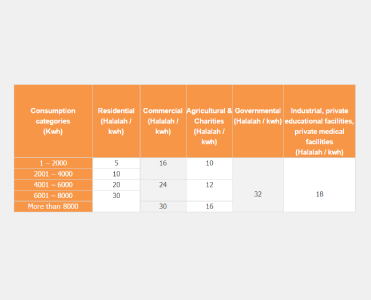
    Saudi Electricity Company has updated the Tariffs on its website for all sectors. 

  • Saudi Electricity Company guidelines for Industrial Electricity Consumption Rationalization

    Saudi Electricity Company guidelines for Industrial Electricity Consumption Rationalization

    Effecient use of Electricity in Industrial Sector. Control what you can.
    Effecient use of Electricity in Industrial Sector. Control what you can.

    An excerpt from the Saudi Electricity Company website that highlights the important of utilizing natural and efficient resources to reduce overall electricity demand. 

    INDUSTRIAL SECTOR  

    The industrial sector represents a major tributary of the economic and cultural development in the Kingdom of Saudi Arabia.

    Power Coefficient Improvement :

    The power coefficient is defined as the ratio of effective capacity to total capacity. It is an indicator of the electrical power consumption efficiency of  the machinery used in a manufacturing facility.  A low coefficient in a facility leads to lack of full utilization of capacity and increases the flow of current in the electrical network thereby increasing electric power losses and other problems in the internal network of the customer and the electrical network as well. The power coefficient could be improved by using capacitors that are installed in parallel with the equipment, which is useful in the following aspects:

    • An additional increase to the carrying capacity of the factory network
    • Stability of the network’s voltage
    • A decrease in the electricity bill by decreasing the losses and avoiding the penalties that are entailed for the low power coefficient.  This means that it is lower than the allowed level.
    • Improvement of the power coefficient (not less than > 0.9) to reduce losses and promote full utilization of machineries and equipment capacity.

    Power coefficient Information :
    The power coefficient (some people use factor) is defined as the ratio of the effective capacity / power (KW) of the total capacity / apparent power (KVA).

    Power Factor   = Effective power                        kw

    Apparent power KVA                     

    A decline in this indicator (PF) means that you have a loss difference (variation) between both powers called the nonproductive reactive power (Kvar) which overburdens the electric grid in your factory and thus obligates you for more extension.

    And if you were not paying a compensation for the nonproductive power in the monthly consumption bill directly, then you will have to pay for the indirect expenses and costs as a result of low power factor / coefficient). As long as you have a distribution network, breakers, and other electric fixtures in your factory.

    Advantages of the power factor / coefficient (PF) improvement for the factory

    1 – Increase to the carrying capacity of the factory network:

    Often you need to expand or extend of electrical fixtures in your factory; an issue that requires an increase in the required electrical capacity, necessitating more investment in the form of power grid extension in your factory. The improvement of the power coefficient saves a significant quantity in the carrying capacity of your current network. It allows you to add more loads without the need for the enlargement of the network’s size which in turn results in a decrease of the required financial expenses for the change or modification of the network to be placed with the development of your loads.

    Example : A factory with the following characteristics (KVA = 1000, KW = 800, KVAR = 600, PF = 0.8)

    If the PF was improved to (0.96) : Then that will increase the power capacity provided by the network to (20%), which means that the electrical network in the factory will be able to provide (960) KW with an increase of (160) KW.

    Increase to the carrying capacity of the factory network

    This increment in the carrying capacity of the factory’s network is represented in the increase in carrying capacity of each of :

    Transformers :

    If we assumed that your PF is equal to (0.7) then it means that a transformer with the capacity of 100 KW in your factory cannot carry more than (700) KW, and at the time of PF improvement to (0.9) the same transformer could deliver (900) KW, i.e. the carrying capacity of the transformer increased by (200) KW.

    Cables :

    The cables are gradually loaded to their maximum capacity at the decreasing PF in pursue with the increase in nonproductive capacity through which it passes e.g. at a PF (0.7) we need a cable which section must be double the section of the cable we need at a PF equivalent to 1 for the same load. 

    Power Factor , Conductor Cross Section

    2 – Voltage Stability :

    The improvement of the PF will spare the factory the problems of low voltage represented in the following :

    – Motor runs slow and its temperature increases.

    – Increase in temperature of the cable due to increase in current.

    – Effectivity of the electronic control devices working as the improvement of PF increases the electric voltage in the network branches.

    3 – Retrenchment of Electricity Bill :

    As the losses in the network (IR) are inversely proportional to the power factor, the improvement of the power factor (PF) at each of the load points will reduce the nonproductive current passing through the factory network and thus less current will pass to the network thereby resulting in a lower kilowatt hour (KWH) consumption appearing in your bill.

    – Optimal use of electric power in factories :

    – Establish a specialized unit to monitor the loads and the application of methods to raise the efficiency of the use of electric power.

    – Carry out a review of the guidelines for the optimal use of air conditioning, lighting, and insulation as per the leaflets issued by the Company.

    – Change work pattern and shift the electric load to out of peak time (1 pm – 5 pm).

    – Use of spare generator for electric feed during peak time in coordination with the Company.

    – Carry out periodic maintenance during summer season.

    – Use of the auto control system for air conditioning loads and separate it from other loads.

    – Use of high efficiency machinery and replacement of the old with new ones of high specifications.

    – For a better efficiency of the internal combustion systems, and lower fuel consumption, you must run the thermal furnaces and boilers according to absorption capacity designed for this purpose

    – It is necessary to use thermal insulators of high efficiency in walls of thermal furnaces and boilers

    – Limit production during summer and increase it during winter.

    – Teach the workers about the importance and the various methods to conserve electricity.

    – Installation of Load Control Management System.

    – Installation of sensor units that switch off lights in areas that are unused.

    – Seeking the assistance of a power auditing company to review your consumption and find energy saving areas.

    – Use of high efficiency devices for lower power consumption.

    – Installation of thermal insulation in non-insulated areas. 

    – General Guidelines :

    Dear Factory owner, your compliance with the following guidelines will contribute effectively to the achievement of a notable reduction in electricity consumption.

    Thus, we hope you will follow the following guidelines :

    – Thermal Insulation :

    – Use of thermal insulation in the existing and new buildings.

    – Use of sun-reflective thermal panes.

    – Air conditioning :

    – Perform air conditioner maintenance once a year.

    – Clean air filter on a monthly basis.

    – Keep windows closed whenever air conditioner is in use.

    – Switch off the air conditioner when leaving the place.

    – Set the air conditioner’s thermostat at medium temperature.

    – Shade the outdoor air conditioner from direct sun light.

    – Lighting :

    – Utilize the natural light as much as possible.

    – Use energy-saving lamps.

    – Switch off lights when not needed or when leaving the place.

    – Use multiple switches to distribute lighting especially in grand halls.  

    from: https://www.se.com.sa/en-us/Pages/IndustrialSector.aspx 

  • International Year of Light

    International Year of Light

    Light plays a role in every aspect of our lives. We rely on it to brighten our homes and businesses. We use light-based technologies in our smart phones, tablets, laptops, and DVD players. You’ll even find them in use at the grocery store, the airport and the doctor’s office. 

    No doubt about it, light is a vital part of our world. 

    Perhaps that’s why the United Nations has proclaimed 2015 the International Year of Light. Over the years, lighting experts, technology leaders and the brightest scientific minds will convene to explore and discuss ways that light-based technologies can be used to solve some of the world’s most challenging problems—problems like energy consumption, agriculture, health and education. 

    For our contribution, Solatube International, Inc. will continue to work on improving education by growing our established educational daylighting program. Through this initiative, we provide free Solatube Daylighting Systems to qualifying U.S. schools and universities. The units deliver natural light that helps students concentrate, perform better on tests, and work more productively. They also cut electricity costs, allowing more money to be put into the classroom and less into utilities. 

    EGPHIL Solar Solutions joined SIBCO – Pepsi in April 2015 to celebrate the Year of Light for their project of applying Solatube Daylighting System in their Distribution Center in Jeddah. 12,000 sqm. of warehouse fully lit by daylighting.

    Solatube International’s recent efforts benefited Newington High School in Newington, Conn., a facility that hadn’t been updated for 40 years. The school’s media center was the main focus of the project. Surrounded by corridors and classrooms, this section of the building had no access to natural light. 

    The space was brightened using several Solatube Daylighting Systems, installed by the Solatube Commercial Distributor for New England, Willco Sales & Service.

    “I was impressed with the difference natural daylight brought to the room,” said Architect Kevin Lipe of Jacunski Humes Architects. “Before the project, turning off the room lights left most of the space in darkness and brought to a stop whatever activities were underway. Now, turning off the lights causes an almost imperceptible change to light levels and activities continue on uninterrupted. Solatube Daylighting Systems greatly enhance the quality of ambient light throughout the space without shadows, glare or direct sun.”

    Thanks to the new units, students now have access to better, brighter lighting. The school can also reduce its energy use since traditional electric lights can be left off during the day.

    As the International Year of Light continues, we’ll continue to do our part to solve the world’s problems as they relate to education and energy consumption. In fact, plans are already in the works to install units in additional educational facilities domestically. We’re even looking to expand our program outside the U.S. to ensure children in schools all over the world have the lighting they need to study and learn. 

    Solving the world’s problems won’t happen overnight. But with awareness building initiatives like the International Year of Light and educational improvement programs like the one we’ve put into place, we’ll continue to chip away at it. One school at a time.

  • Impact of better indoor conditions on productivity of employees

    Impact of better indoor conditions on productivity of employees

    World Green Building Council report makes the case for Natural Ventilation – it’s not about saving energy – it’s about saving staff!

    Making the Case for Natural Ventilation and the importance of proper ventilation in a workplace.

    Latest Blog post by Breathing Buildings Consulting Engineer Owen Connick.

    Last week I represented Breathing Buildings at Carillion’s London workshop for suppliers offering innovative products, which Carillion believe can be effectively rolled out across their business. During the workshop I enjoyed numerous highly interesting discussions, both with other suppliers in attendance and with Carillion staff, in particular Chief Engineer Euan Burns, who recommended I read the World Green Building Council’s latest report on ‘Health, Wellbeing & Productivity in Offices’.

    In 2013, WorldGBC reported on ‘The Business Case for Green Building’, highlighting research which demonstrated that green buildings could enhance health, wellbeing and productivity for occupants.

    The 2015 report is an attempt to build momentum on the same topic – to make the business case in favour of sustainable (green) building – and to provide a framework for better measurement of these factors; leading to more consistent data, and more evidence to inform investment and design decisions.

    WorldGBC Report

    The authors begin with an aspiration:

    “if the human benefits of green building could be reliably quantified this would prove, beyond all doubt the ROI for building green.”

    However, this optimism is immediately followed with a surprising home truth:

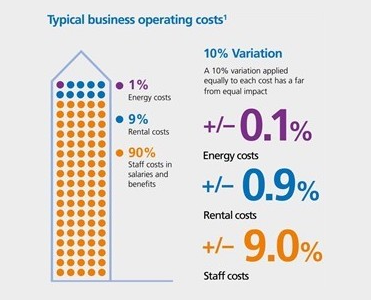
    Energy costs make up just 1% of total operating cost for a typical business.

    One percent! This implies that a 10% saving on energy cost actually represents just 0.1% saving on total operating budget – not exactly the significant savings we like to imagine. Despite, and perhaps because, energy costs are such a small fraction of total operating costs, WorldGBC present the case that the benefits of green buildings go far beyond a simplistic measure of energy savings.

    Overwhelmingly, research clearly demonstrates that the design of an office has a material impact on the health, wellbeing and productivity of its occupants. Staff costs, including salaries and benefits, typically account for about 90% of a business’ operating costs. It follows that the productivity of staff, or anything that impacts their ability to be productive, should be a major concern for any organisation.

    Commenting on the relationship between a building and its users, the report states:

    … it is increasingly clear that there is a difference between office environments that are simply not harmful – i.e. the absence of ‘bad’ – and environments that positively encourage health and wellbeing.

    Summarising the evidence in favour of green building practices, the authors break office environments into 9 factors. First and foremost amongst those is Indoor Air Quality, closely followed by Thermal Comfort.

    Indoor Air Quality

    The health and productivity benefits of good indoor air quality (IAQ) are well established. Whilst the results of individual studies cannot automatically be applied to any building, a comprehensive body of research can be drawn on to suggest that productivity improvements of 8-11% are not uncommon as a result of better air quality.

    Thermal Comfort

    Again drawing on a comprehensive body of evidence, the report summarises that thermal comfort has a significant impact on workplace satisfaction. With studies consistently showing that

    … even modest degrees of personal control over thermal comfort can return single digit improvements in productivity.

    Further factors affecting occupants include daylighting & lighting, biophillia, noise, interior layout, look & feel, active design & exercise and, finally, amenities & location. These arguments, in essence, make a compelling case for green building practices; not on a cost & energy savings basis, but on a human benefit basis, in the form of improvements to health, wellbeing and productivity.The findings undeniably affirm that buildings can maximise benefits for people (occupants), andleave the planet better off; the end result being low-carbon, resource-efficient, healthy and productive buildings.

    Fundamentally, this is about better practice and higher quality building – period.

    The report was sponsored by JLL, Lend Lease and Skanska, and includes contributions from a large working group of industry, policy and academic experts from around the world.

    http://www.worldgbc.org/activities/health-wellbeing-productivity-offices/