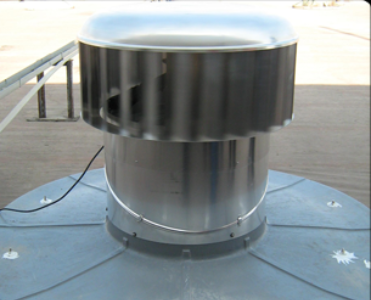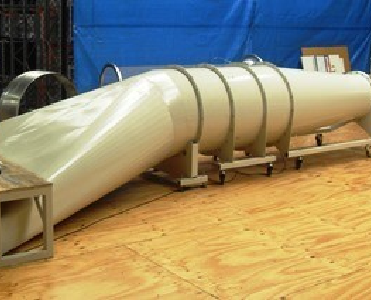
There are now a large variety of wind powered ventilator designs in the marketplace and just as wide a range of performance claims. A lot of the claims exceed that available from similar size mechanically driven axial fans tested to ISO 5801. Clearly impossible.Most performance claims also make no reference to established standards or tests. Edmonds undertook extensive test work using established standards to unequivocally determine the true capability of natural ventilators. For the first time, ISO 5801 has been adapted to assess performance of natural ventilators and results compared with AS/NZ 4740 – at present the world’s only published standard for performance testing of natural ventilators. This ground breaking work established (1) that flow rates determined under both test procedures at nil pressure loss were virtually identical and (2) that pressure performance curves could be developed for natural ventilators but, as expected, vindicated that at average conditions, natural vents will struggle to manage more than 5Pa pressure loss. Even the Edmonds Hurricane 900mm flagship natural ventilator could only exhaust 3,340 m3/hr under average wind speed conditions, stack height of 8m and temperature differential of 10C. Yet no other tested ventilator design using a round base could reach even this level. To view this paper please proceed to the link below.
We know them from the front doors of our homes – motion detectors. They switch on the lights when we approach the entrance. Sometimes they also switch them on when a neighbor’s cat walks by. But can such systems be used in cities and companies?
Streetlights today have set hours and daylight levels at which they are switched on – irrespective of the traffic volume. Cities and companies can easily install sensors and advanced lighting management systems on their exterior luminaires.
We are convinced that smart outdoor lighting management systems are the future. Lighting managers want to save resources, enhance safety and still meet individual lighting needs. In the years to come, many municipalities and companies will rely on motion detectors that improve people’s quality of life and offer them more safety.
The use of outdoor motion detectors has many advantages for cities and companies:
Saving energy and operating hours
If lights in places with little traffic at night, such as parks, industrial areas or regional stations, are switched on on an on-demand basis, operators save electricity and also extend the service life of their systems by reducing the number of operating hours.
Less light pollution
In large cities in particular, unnecessary permanent lighting causes problems for people and animals – sensors on luminaires protect our environment.
More safety
By using sensor-controlled lights, lighting technicians can also make problematic areas such as underpasses, sports grounds or company premises at risk of vandalism safer. Surveillance cameras are also dependent on light, for example, in order to be able to capture usable image material. Here, sensors can switch up to higher light levels during movement.
Motion detectors therefore help cities and companies to reduce lighting and use it in a more targeted way at the same time. Lighting adjustments are no problem either – when an event takes place in a park, the city can deactivate the motion sensors and set a manually controlled high lighting level for the evening.
It is also important that the motion detectors – unlike those on the front door – monitor their environment particularly reliably and are not triggered when cats pass by or trees sway in the wind. The technology already meets these special requirements: Modern passive infrared sensors can, for example, ignore tree movements during windy conditions and also distinguish small animals from pedestrians.
The intelligent lighting control system automatically dims down street lighting into idle mode during off-peak traffic times. The brightness of the each luminaire is reduced to 20 percent. As soon as human activity is detected, for example pedestrians, cyclists or vehicles, the luminaires in the surrounding area increase their brightness to the standard level.
Sensor technology has made great progress in recent years. This makes it worthwhile for users to get started. Further innovations are to be expected in the future – perhaps we will soon be able to control the light colour according to our needs or use cameras as motion detectors, offering us even more evaluation options.
Edmonds, The innovators of turbine ventilators, take a further step to confirm being the best in its technology
Edmonds has become a member of AMCA and will now be using this august body to undertake all future testing and certification for its mechanical and hybrid (i.e. ecoPOWER) ventilators. AMCA certification is highly regarded around the globe.
The first initiative was to send our ecoPOWER 400 and 600 hybrid vents to AMCA for full evaluation of flow rate, fan curves and power usage followed by full noise analysis. The results can be summarized as below:
Top flow rates were generally about 5% higher than Edmonds has previously published.
Fan curves showed a significantly higher capacity to manage pressure loss than Edmonds had hitherto published. In general about a 20% improvement across the curves.
Power consumption when running was about 10% less than Edmonds had previously claimed meaning even greater levels of energy efficiency.
Noise figures are far superior to any other mechanical device for the flow rates experienced.
Further tests will be carried out for the remaining series of products.
Edmonds is now encouraging AMCA to set up the capacity for CERTIFICATION of wind powered and static ventilators possibly using AS/NZS 4740 or some derivative thereof. AMCA certification for wind powered ventilators will be a huge step forward for an industry which has currently has poor discipline and no commonly accepted basis for many flow rate claims.
We are proud to announce that our distributed product, Ecopower EP600 and EP900 from EDMONDS is SASO Certified.
At the TUV Rheinland labs the motor on the ECOPOWER 600 and ECOPOWER 900 models were tested in accordance with the SASO/IEC 60335.2.80:2002 / SASO/IEC 60335.1.2010, SASO 1062:2007.This certification allows us to openly market the product in the region and quickens its importation.
Ecopower Series of Hybrid Ventilators have a highly efficient EC Motor that consumes about 75% lesser electricity, 25% lesser noise, and about 70% lesser weight. When the motor is off, these fans function as natural ventilators and help maintain favorable indoor environment of the building.
Recently, the company has also introduced their new line of Ecopower product which has control options.